
Annelise Kretschmer, picture of Christiane Kretschmer, 1965: ©Nachlass Annelise Kretschmer, LWL Museum für Kunst und Kultur, Münster
Exhibition
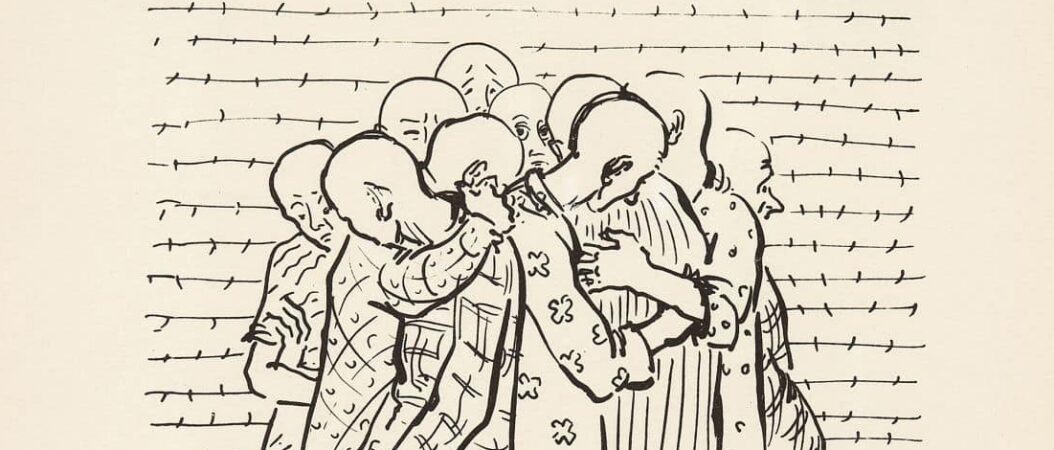
In a compelling dialogue between the drawings of Shoah-survivor Ágnes Lukács and the installations of contemporary artist Burkhard Schittny, the exhibition addresses the preservation of human dignity under inhumane conditions.
Hunger, fear, and despair defined life in the concentration camps of the Nazi dictatorship—a system designed to dehumanize the prisoners. The struggle for survival—but also for the preservation of human dignity—is powerfully reflected in the works of Shoah survivor Ágnes Lukács. The Hungarian-Jewish artist survived Auschwitz and various satellite camps of Groß-Rosen and Neuengamme. She documented her experiences in the camps through drawings, prints, watercolors, and oil paintings.
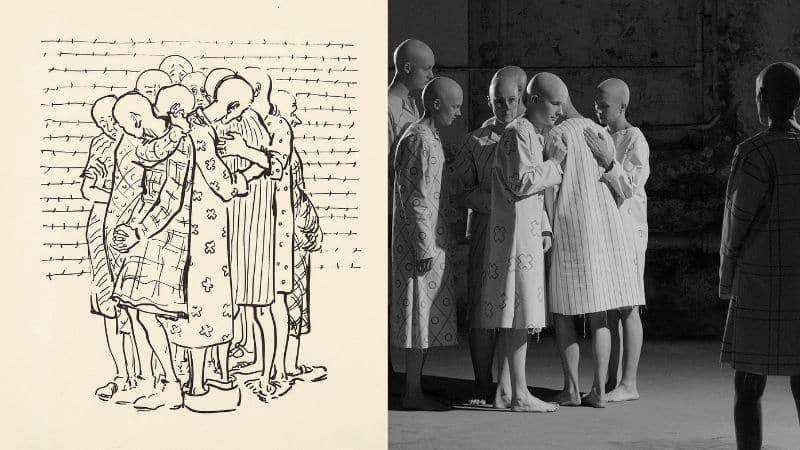
Burkhard Schittny, an artist living in Hamburg, discovered her work a few years ago and began collecting her paintings. Several years ago, his intensive engagement with the work “Összebújva” (“Close Together,” 1945/46) gave rise to a work of his own. In “Összebújva,” Ágnes Lukács expresses female solidarity in the face of oppression in the women’s camp at Auschwitz—a motif she repeatedly revisited and reworked. In the film “Dignity – Tribute to Ágnes Lukács” (2021), Schittny makes a direct reference to this drawing and transposes it into the present. Like Lukács, Schittny uses “Dignity” to take a stand against the dehumanization in the concentration camps, in an effort to restore dignity to those depicted.
Starting October 18, 2026, the Jewish Museum of Westphalia will present works by Ágnes Lukács from Burkhard Schittny’s collection as well as from the museum’s own collection, juxtaposed with art installations by Burkhard Schittny on the themes of persecution and forced labor. This creates a compelling dialogue between a Shoah survivor’s perspective on the struggle to preserve dignity under inhumane conditions and a modern view of today’s responsibility to restore that dignity. A catalogue will be published to accompany the exhibition.
 Exhibition

 Member Update
 Exhibition