 Board
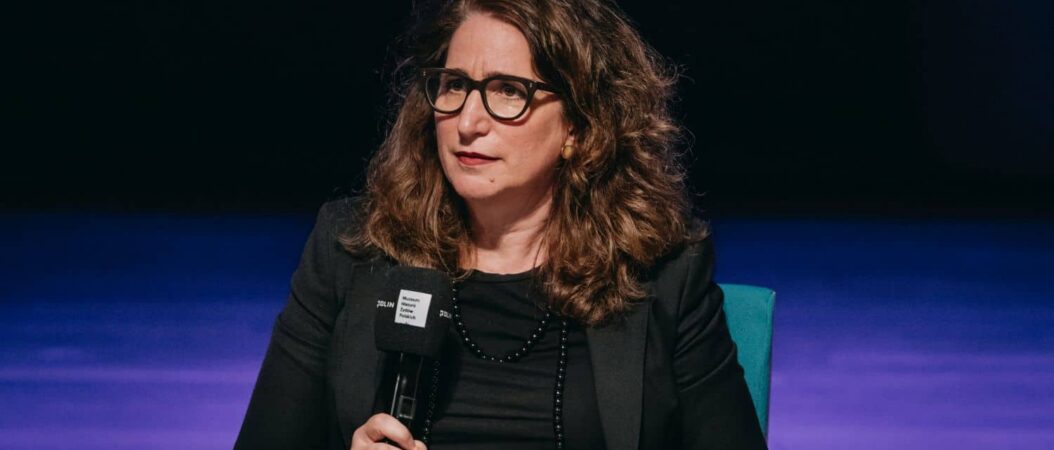
Photo: Maciek Jazwiecki
Interview with AEJM Chair Mirjam Wenzel in the Memorial Museums Newsletter
The interview appeared in issue No. 223 (October 2026) of the Memorial Museums Newsletter (Gedenkstättenrundbrief), a monthly publication of the Memorial Museums Department at the Topography of Terror Foundation in Berlin. Mirjam Wenzel, director of the Jewish Museum Frankfurt and Chair of the AEJM, discusses the growing professionalization of Jewish museums in Europe, the impact of rising antisemitism since October 7, 2023, and the importance of transnational solidarity and partnerships with memorial institutions.
Julana Bredtmann (JB): AEJM was founded in 1989 as a network primarily connecting museum directors in Europe. Was that always its role? And if not, how did it change?
Mirjam Wenzel (MW): When the Association of European Jewish Museums was founded, fewer Jewish museums existed in Europe than today. And those that were already established were considerably smaller. Moreover, most of the existing Jewish museums were run by an Association or a Jewish community and therefore not public institutions. These first post-Holocaust Jewish museums usually had between three and ten staff members (mostly curators and craftsmen) as well as many freelance workers and volunteers. Henceforth, their structure had a certain resemblance to the Jewish museums that existed before World War II. Consequently, in both cases, the director was the key figure — and frequently the only person — with overall responsibility for the museum’s development. This has changed in the past twenty-five years with the emergence of larger Jewish museums, some of which are even national institutions.
JB: With around seventy member institutions, AEJM is the largest European network of Jewish museums. What are the differences and what are the common challenges of AEJM’s member institutions?
MW: The Association of European Jewish Museums is not only the largest but also the only existing network of Jewish museums in Europe. It was founded as a topic-specific alternative to the International Council of Museums (ICOM) when the iron curtain was about to fall. Its establishment responded to the need for Jewish museums throughout Western and Southern Europe to come together and to talk about common tasks like conveying Jewish culture to largely non-Jewish audiences. And it was inspired by the desire to build up connections with colleagues and institutions in Eastern Europe such as the Hungarian Jewish Museum and Archives, the Jewish Museum in Prague or the Vilna Gaon Museum of Jewish History in Vilnius.
The main difference between the members of the AEJM was back then — and still is to this day — defined by the relationship to the respective local Jewish community: Jewish museums in Italy and Greece as well as in Budapest and Bratislava are part of the local Jewish community infrastructure. Jewish museums in France, Belgium, the Netherlands, the Czech Republic and England have representatives of the communities on their boards whereas Jewish museums in Scandinavia are quite detached from any community involvement. These differences have an impact on the structure of the museums and their audiences. While Jewish museums in places with no or small Jewish communities tend to function as places of memory and to focus on education for largely non-Jewish audiences, Jewish museums that are embedded in a community fabric are memory institutions for the local material heritage. Therefore, they’re mainly collecting Judaica objects and addressing preferentially Jewish audiences with their programmes.
JB: Why has AEJM so significantly expanded the professional training programme in recent years? What role does professional development play for the network and what skills are the most important?
MW: In recent years, the Association of European Jewish Museums underwent a major transformation from a family-like network of familiar colleagues to an organisation of museum professionals that is dedicated to further developing the field of Jewish heritage institutions — in terms of professional knowledge as well as advocacy for Jewish heritage in Europe. This development mirrors the emergence of many new Jewish museums, among them national institutions such as the Jewish Museum Berlin, POLIN Museum for the History of Polish Jews in Warsaw and MEIS Museo Nazionale dell’Ebraismo Italiano e della Shoa in Ferrara or privately funded institutions such as the Lost Shtetl Museum in Šeduva (Lithuania) and the Jewish Museum of Switzerland in Basel. With these and other new institutions, the field of Jewish museums has changed tremendously. Whereas the first post-Holocaust Jewish museums were operating in a niche, today’s Jewish museums are situated in the midst of almost all European capital cities and address core topics of our times such as migration, diversity and memory. The new relevance of Jewish museums came along with political pressure and attacks in times of polarised discourses and growing antisemitism that made training for the museum staff even more necessary.
JB: AEJM conducted a survey among its members on the impact of the 7 October 2023 attacks on their institutions. The results point to a significant rise in antisemitic incidents affecting many institutions across Europe. Which findings do you find most insightful?
MW: AEJM conducted two surveys among its members after 7 October 2023 with comparable results. The second survey in 2025 further underlined the deep structural impact of the violence and war in Israel and the Middle East on the work of Jewish museums in Europe:
- 72 % of museums reported an increase in negative exposure on social media;
- 60 % faced a rise in digital hate speech;
- 60 % report cancelled partnerships or opportunities either increasing or occurring for the first time;
- 44 % were facing a decline in visitor numbers; in some museums, the decline exceeded 30—40 %.
It was important for the Board of AEJM to find out how museums reacted to these developments:
- 64 % implemented increased security measures;
- 44 % introduced staff training;
- 40 % expanded educational outreach;
- 32 % issued public statements.
The different measures in reaction to increased antisemitism reflected an effort to strengthen institutional resilience while maintaining public presence. Nevertheless, the overall results of the survey are disturbing and deeply sad — not only with regard to Jewish heritage institutions in Europe …
JB: How should and how can museums and networks such as AEJM act regarding antisemitic incidents? What responses are needed?
MW: Within the Board of the AEJM, we are constantly discussing precisely this question. If one of our members is subject to relentless criticism, open hate, cancellations or under pressure, we write letters to its stakeholders and issue public statements. Recently, we started to extend this advocacy to the broader field of museums in Europe, demanding from museum colleagues to refrain from fostering antisemitic narratives in their exhibition spaces. This is a particularly bold but necessary task in the field of contemporary art.
Nevertheless, our main attention goes to the needs of our members: what do they require in order to counteract antisemitic narratives? Since 7 October, we provided several training courses particularly for museum colleagues in the field of communication and education in order to enable them to develop appropriate strategies to both identify and dismantle antisemitic narratives.
JB: AEJM’s annual conferences and professional programmes create spaces for exchange beyond national borders. From your personal perspective, what kinds of knowledge, resilience or solidarity can emerge specifically through transnational cooperation and in-person meetings?
MW: Since I started working at the Jewish Museum Berlin in 2007, I’ve always attended international conferences in order to get to know cutting-edge projects and trends in the field. I kept doing so after I became director of the Jewish Museum Frankfurt in 2016 but, unfortunately, I had the experience that, after 7 October 2023, colleagues I hardly knew felt the need to discuss Israel and Gaza with me or to speak about genocide when I was entering the room of an international conference. I realised that the fact that I lived in Israel for two years in the 1990s was a provocation for them and that they weren’t willing to acknowledge the difference between diasporic Jewish experiences and the conflict in the Middle East. Therefore, I am currently avoiding broader international museum conferences and am enjoying the opportunity to work with other colleagues in the field of Jewish heritage and culture as well as with Jewish organisations under the umbrella of the EU strategy of combatting antisemitism and fostering Jewish life.
The annual conferences, online workshops and board meetings of the Association of European Jewish Museums are a very empowering experience. They give me the strength to keep on doing what we do, together.
JB: And finally, what do Jewish museums need most right now from political decision-makers, funding bodies and cultural partners, including memorial museums?
MW: Jewish museums have the capacity to tell stories that are particularly meaningful for our present times — not only with regard to discrimination, persecution, displacement and genocide (the thematical focus of most memorial museums) but also with regard to the fight for equal rights, the experience of migration, religious traditions and ethical values of a community whose history and culture has shaped European civilisation. In order to tell this story in an impactful way, Jewish museums need reliable cultural partners in the non-Jewish world like memorial institutions, art or cultural historical museums. For the development of changing exhibitions, the latter can become very important, but when it comes to political issues, Holocaust museums and memorial sites are somewhat »natural« partners for Jewish museums. In the US, Holocaust museums are even part of CAJM, the Council of American Jewish Museums, our partnering network. So, wouldn’t it be nice if we could, once in a while, organise a conference together in order to share the experience that we have on the impact of changes in society for our work?
Related:
Board
 News
Funding for Jewish heritage professionals to attend a conference or participate in a seminar or specialist training course
 News
European Days of Jewish Culture 2026: LOVE

Photo: National Holocaust Museum Amsterdam
Training